Demand moves before the reorder
Last month's sales look strong. Your next delivery is months away. Buying depth needs to account for what may change before it arrives.
I help white-label and private-label consumer brands decide what to buy, assess China-based suppliers, understand true landed costs and build reliable operations. Eleven years across China–Europe trade lanes inform every recommendation. AI speeds up the analysis; commercial judgment guides the call.
For founders, category and operations teams selling across Europe, the UK and beyond.
Last month's sales look strong. Your next delivery is months away. Buying depth needs to account for what may change before it arrives.
Freight, duties, payment terms and minimum order quantities (MOQs) change the cost of the buy. A low unit price can still tie up too much cash.
Lead times sit in an email. Quality notes live in a spreadsheet. Your team needs that evidence together before it commits to the next order.
I bring demand signals, sell-through, lead times and supplier constraints together to assess what to buy, how deep to buy and when to reorder. AI helps organise the information; I challenge the assumptions behind the recommendation.
I make the assumptions and risks visible, so you can judge the recommendation before committing cash. Detailed SKU analysis is part of a separately scoped engagement.
I define the shortlist and evaluation process. China-based partners execute supplier and factory checks, so you can assess the evidence before choosing a supplier.
I model quotes, freight, duties, payment terms and currency assumptions, so you can compare margins and cash exposure before paying a deposit.
I connect reporting, supplier follow-up and operational documentation with clear owners and review points, so your team can repeat the work reliably.
More about my advisory services and AI-assisted operations. For a practical starting point, use my private-label sourcing checklist for China to the EU and UK. For the next stock commitment, work through the inventory reorder planning example.
A product went viral on Amazon. Sales accelerated. The obvious next move was a bigger order. I advised against it. A viral moment tells me that people are paying attention — not how long they will keep buying. I needed more than a sales spike: a view of demand, timing and the cash at risk. That is the judgment I bring to AI-assisted work today.
This was an operating decision, not an AI engagement. Today I use AI to explore the evidence; I remain accountable for my recommendation.
Mid-pandemic, with home fitness flying, I asked a client to cut his buying depth in home gym while the numbers still looked strong. Source-side order books were already thinning. The downtrend arrived weeks later, the moment lockdowns eased. The category died on schedule. His exposure didn't.
Right. And it only worked because he acted on it.
Products I flagged on the hall floor and never backed with a calculated bet were trending across Europe six to eight months later. Being right and not acting is still a loss.
That notebook is why my method now forces the position — small, and early.
Early on I stayed emotionally invested in winning products until they turned hostile — reordering out of loyalty long after the demand had left.
The rule is mechanical now: the moment a favourite stops earning its reorder, it's inventory, not identity.
These are the calls I can stand behind in a room with your order book open. The misses stay on the page because they shaped the method more than the wins did.
I review product economics, lead times and supplier constraints, so the analysis reflects the buy you can actually make.
I agree what your team needs to decide and which evidence it can trust, so the work has a clear purpose.
AI helps organise research, reports and supplier notes, so you can compare the options in one place.
I check assumptions and flag uncertainty. Your team reviews the recommendation before it approves a purchase or process change.
I start with the workflow your team needs to fix. The scope sets which steps AI can support and where human review is required.
I organise listings, reviews and demand signals to assess the evidence behind your next category decision.
I bring supplier records and check findings into evaluation notes, so you can see risks and prepare the negotiation.
I compare landed-cost scenarios for quotes, freight, duties and currency, so you can see which assumptions move the margin.
I review sell-through and lead times to support buying depth and reorder timing, with assumptions your team can check.
I summarise inspection and defect notes into supplier scorecards, with the original evidence available for review.
I turn agreed processes into reporting templates and SOPs, so your team knows who owns each step and when to review it.
I’m Prateek Lalwani, a Madrid-based supply chain and sourcing consultant. I’ve spent eleven years working across China–Europe trade lanes, where a buying decision affects cash, margin and the next delivery. I now combine that operating experience with AI-assisted research and practical systems that teams can use.
China-based partners handle on-the-ground supplier and factory checks to the process I define. I review the findings alongside your product economics and buying constraints.
I treat your brand, supplier relationships and commercial details as confidential. I welcome an NDA before you share sensitive information.
Confidentiality is my quiet standard.
Your suppliers, your margins, your playbook — never leave this room. No case studies with your name on it. No name-dropping to win the next client. What I build for you stays yours.
Formalised by NDA before any commercial detail is shared. Privacy policy.
Prateek Lalwani
Certifications
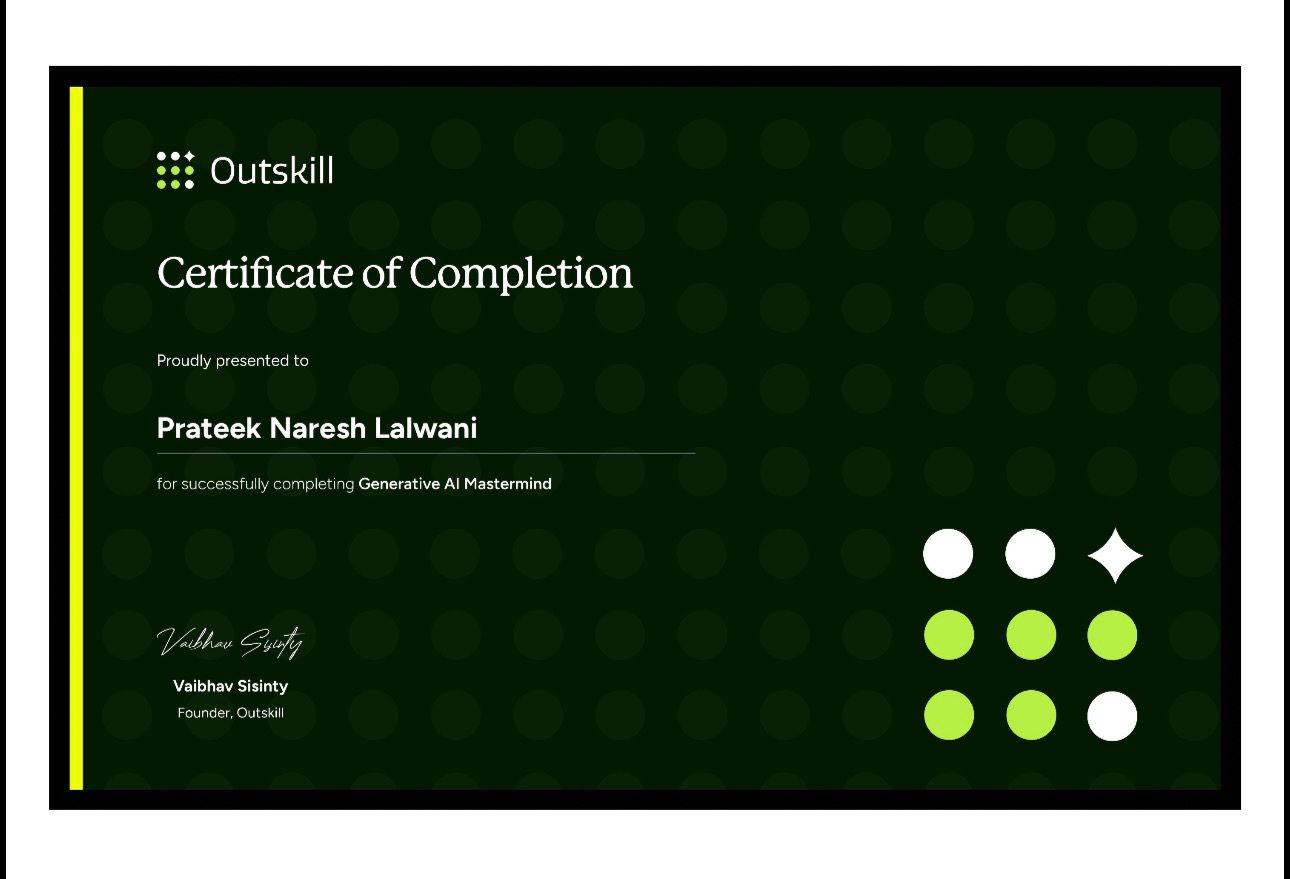
I continue developing my AI skills through formal training. This certificate records my course completion; my operating experience informs how I apply those skills.
Outskill
Certificate of completion awarded to Prateek Naresh Lalwani for Outskill’s Generative AI Mastermind programme.
Every engagement is scoped to your business. The introduction helps clarify priorities and a next step; detailed diagnostics and advisory work are agreed separately.
Tell me what you’re buying, where the decision gets stuck, and what happens if you get it wrong. We can discuss the category, supplier constraints, margins or a workflow your team needs to fix.
Confidentiality is my quiet standard
Prefer to write first?